

5.56 and .223 Picks for Training, Defense, and the Field
If you own an AR-15 — and a lot of you do — your ammo choice is more nuanced than it is for most platforms. The AR-15 in 5.56 NATO gets used for more different things than almost any other rifle: plinking and training, home defense, varmint hunting, deer hunting in appropriate states, and competition. Each application has a different optimal load, and the wrong ammo choice in the wrong context doesn’t just underperform — it can be genuinely unsafe.
We’re breaking this down by use case so you can stock the right ammo for what you’re actually doing, rather than picking one round and hoping it covers everything.
First: The .223 vs 5.56 Question You Need to Answer
Before the ammo discussion, the chamber discussion: your rifle is either chambered in .223 Remington, 5.56 NATO, or .223 Wylde. This matters more than most shooters realize.
A .223 Remington chamber can safely fire .223 ammo. It should not fire 5.56 NATO ammo. 5.56 is loaded to higher pressures than .223, and a 5.56 round fired in a .223 chamber can produce dangerous overpressure. The headspace dimensions are different, the leade (the initial unsupported section of the barrel) is shorter in a .223 chamber, and the combination creates a pressure spike that your rifle’s tolerances may not absorb safely.
A 5.56 NATO chamber handles both 5.56 and .223 safely. A .223 Wylde chamber also handles both — it was specifically designed to accept 5.56 pressure levels while maintaining .223 accuracy. Most modern AR-15s ship with 5.56 or Wylde chambers. Check your barrel markings before you buy ammo.
“A 5.56 NATO round fired in a .223 Remington chamber can produce dangerous overpressure. Check your barrel markings before you buy. This isn’t a small-print warning — it’s the first rule of AR-15 ammo selection.”
Training and Plinking: Stock It Deep, Buy It Cheap (But Not Too Cheap)
For high-volume training — the kind of shooting that makes you actually better — you want a reliable, accurate load at the lowest reasonable price per round. The operative word is reasonable. Steel-cased Russian ammo is cheaper per round but runs dirtier, can accelerate bolt carrier group wear, and doesn’t work in all chambers. For most shooters, brass-cased mil-spec 55-grain FMJ hits the right balance.
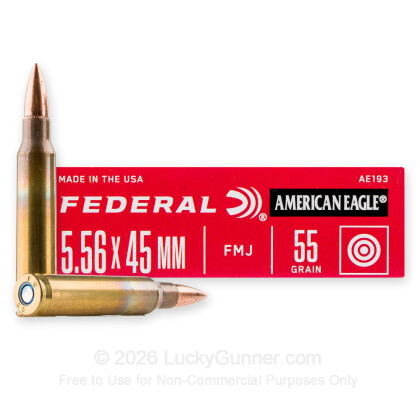
Federal American Eagle
5.56 NATO | 55gr FMJ | Bulk
XM193 is the civilian version of the M193 military ball round. 55 grains, brass case, 3,165 fps muzzle velocity — it’s the benchmark training load against which everything else is compared. Consistent enough for practical accuracy training, priced for volume, and available in 420-round battle packs through Lucky Gunner when you want to stock up. It runs in everything.
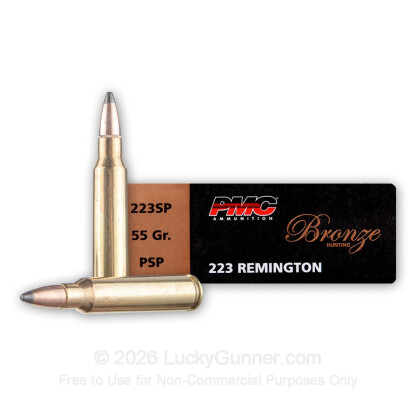
PMC Bronze .223 55gr FMJ
.223 Rem | 55gr FMJ | Budget Brass
South Korean-made PMC is one of the few budget options that uses brass cases, Boxer primers, and consistent powder charges — which means it’s reloadable, reliable, and cleaner than steel alternatives. PMC Bronze in .223 is a safe bet for high-volume training and an easy recommendation for shooters running .223 Remington chambers who can’t fire 5.56.
Home Defense: The Penetration Problem in an AR
Home defense with an AR-15 is a legitimate application that deserves serious thought about ammo selection. The common objection — that a rifle round will over-penetrate through walls — is real but more nuanced than the headline suggests. Certain 5.56 loads actually penetrate drywall less than standard 9mm handgun rounds, because their high velocity causes them to fragment and lose energy rapidly on intermediate barriers.
The key is choosing a load designed for fragmentation rather than penetration. Standard FMJ military ball is not a home defense load. It will pass through drywall with little energy loss. You want a hollow point or a frangible projectile specifically designed for the AR platform.
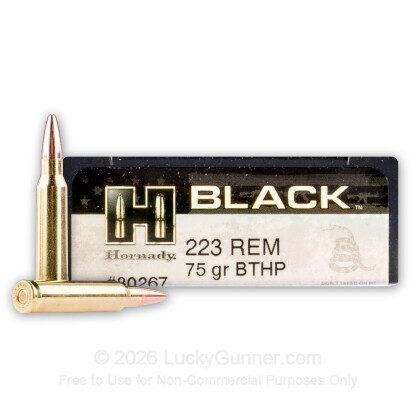
Hornady Black 5.56 75gr BTHP
5.56 NATO | 75gr Boat Tail Hollow Point
The Hornady Black line is loaded to the same specs as Hornady’s law enforcement and military contracts — which means it’s held to tighter consistency than most commercial ammo. The 75gr BTHP is heavy enough to stabilize in 1:8 and faster twist barrels (standard on most modern ARs) and the hollow point design limits over-penetration on intermediate barriers while delivering significantly more energy transfer than FMJ at the same velocity. One of the most versatile AR loads available.
Winchester PDX1 Defender 5.56
5.56 NATO | 60gr PDX1
Winchester brought their PDX1 bonded technology to the AR platform in 5.56, and the result is one of the best purpose-built home defense rifle loads available. The split core/bonded jacket design fragments on intermediate barriers but holds together through soft tissue — producing the combination of barrier safety and terminal effectiveness that a defensive rifle load needs. Available in 20-round boxes, sized for carrying and staging rather than range burns.

Hunting: When .223/5.56 Is the Right Call
In most states, .223/5.56 is legal for deer with appropriate loads, though its suitability is debated. It’s unambiguously excellent for varmints — coyotes, prairie dogs, and similar — where its flat trajectory and fragmentation characteristics are exactly what you want. For deer-sized game, the key is choosing a premium expanding bullet rather than FMJ or standard hollow points not designed for hunting performance.
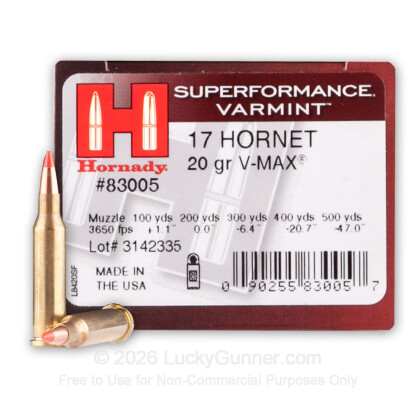
Hornady V-MAX .223 55gr
.223 Rem | 55gr V-MAX | Varmint / Predator
The V-MAX is Hornady’s varmint bullet and one of the most accurate .223 loads available in that weight class. The polymer tip initiates expansion at varmint-appropriate velocities and the fragmentation is dramatic — which is exactly what you want on coyotes and prairie dogs at 200 yards. Accurate enough for precision varmint work, effective enough for running coyotes. If you’re running predator calls this fall, load V-MAX.
Shop at Lucky Gunner
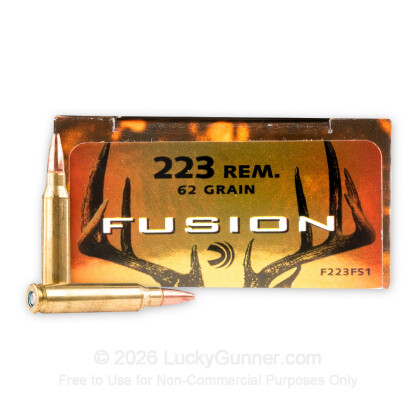
Federal Fusion .223 62gr
.223 Rem | 62gr Fusion Soft Point | Deer / Larger Game
Federal Fusion is purpose-built for deer-class game from rifle platforms. The molecularly fused jacket and soft point tip control expansion in a way that delivers the penetration depth deer hunting requires — unlike varmint bullets that expand too rapidly for effective deer performance. If your state allows .223 for deer and you want to run it ethically, Fusion is the load that makes the case.
The Simple Stocking Plan
Here’s how we’d build an AR-15 ammo inventory from scratch: start with 500 rounds of XM193 or equivalent for training — enough to develop and maintain practical proficiency without burning through premium ammo. Add two 20-round boxes of your chosen defensive load for function testing and staging. Add one hunting-specific load in whatever bullet weight stabilizes in your barrel’s twist rate.
That’s three boxes and a battle pack. It covers training, home defense, and field use without overcomplicating a platform that’s already simple to run well. The AR-15 doesn’t ask much — give it the right ammo and it performs consistently across everything you use it for.