

Embodying ‘something deeper,’ Kelly Worden bridges martial arts tradition and history with innovation and personal transformation.
Story and Photos by Paul Pawela
In 1973, I was 11 years old and devastated to hear that martial arts superstar Bruce Lee had died. I grew up watching
his career blossom, starting with the TV show The Green Hornet, then a few appearances on Longstreet, and finally the big screen with The Big Boss, Fist of Fury, The Way of the Dragon, the blockbuster Enter the Dragon and his unfinished movie
Game of Death. I bought every book that I could get my hands on to learn about Lee’s martial arts styles, from his early style of Chinese gung fu to Jun Fan gung fu (Lee’s name in Chinese) to jeet kune do (Lee’s unique hybrid martial art and philosophy, translated as “way of the intercepting fist”). For me, the art of jeet kune do was more than punching/striking, kicking/kneeing, trapping and grappling.
My martial arts journey officially began with gōjū-ryū karate, then taekwondo and boxing, but it was not until I joined the military and was stationed at Fort Bragg that my real education began. There I met the legendary Ranger/Special Forces hand-to-hand combat instructor Gary O’Neal, who had trained with famed martial artist Michael D. Echanis.
Then my life would be forever changed when I was introduced to Larry Hartsell by Dick Harrell in Charlotte, North Carolina. Hartsell was an original student under Bruce Lee. I would go on to train with other Lee students who would influence me in jeet kune do, like Dan Inosanto, Richard Bustillo, Ted Wong and world champion Joe Lewis. All trained with Bruce Lee.

I also trained with others who trained under Inosanto, including Tim Tackett, Ted Lucaylucay, Jerry Beasley, Cliff Lenderman and Graciela Casillas. After more than 30 years of seminars with these trainers, I managed to earn an instructorship in jeet kune do, yet I still felt something was missing. Then in 2010 at The Water and Steel East Martial Arts Training Camp, I met Datu Kelly Worden, and he forever changed my life.

FOR FIVE-PLUS DECADES, Worden has earned a reputation as one of America’s most respected martial artists. He’s a teacher, author and lifelong student whose influence extends well beyond the dojo. While many martial artists are known for tournament victories or championship titles, Worden has distinguished himself by bridging tradition and innovation, integrating classical martial arts with modern self-defense, leadership and personal development. His career reflects a simple yet profound philosophy: Martial arts are not merely about learning to fight; they are about learning to think, adapt and grow. Worden began his martial arts journey during the explosive growth of Asian martial arts in America. Rather than limiting himself to a single discipline, he immersed himself in multiple systems, studying under accomplished instructors and continually deepening his understanding of combat principles. That curiosity became a defining trait of his career. Rather than viewing martial arts as competing styles, he saw them as complementary methods that could be refined through experience and practical application.
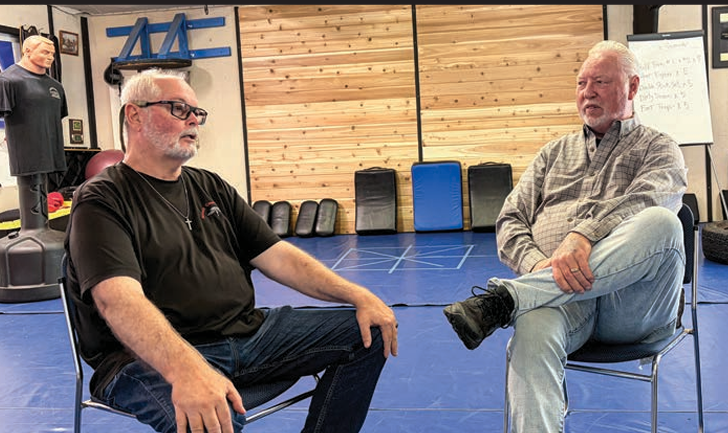
a series of training tactics on the author.
Over the years, Worden earned recognition as both an accomplished practitioner and an exceptional instructor. His teaching emphasizes timing, awareness, balance, efficiency and sound decision-making rather than flashy techniques. Students quickly discover that his lessons extend beyond punches and kicks. He believes that true self-defense begins with awareness, prevention, emotional control and the ability to avoid conflict whenever possible.
This practical approach naturally led him beyond the traditional dojo. Throughout his career, Worden has worked with law enforcement officers, military personnel and security professionals, adapting martial arts principles to real-world situations where judgment, restraint and efficiency are as important as physical skill. His training methods emphasize simplicity under pressure, an approach that has earned respect from professionals whose lives may depend on making the right decision in an instant.
ONE OF THE most significant influences on Worden’s martial arts philosophy has been Bruce Lee’s legacy. Although
Lee passed away before Worden had the chance to train with him, Worden became deeply involved in studying jeet kune do through several of Lee’s first-generation students, like Jesse Glover, Taky Kimura, Bustillo, Inosanto, Lucaylucay and other close associates. Through those relationships, he gained a firsthand understanding of the principles that made Lee’s revolutionary system unlike any traditional martial art. Lee famously encouraged practitioners to “absorb what is useful, discard what is useless, and add what is specifically your own.” That philosophy resonated deeply with Worden and became a guiding principle of his teaching. Rather than treating jeet kune do as a fixed set of techniques, Worden embraces it as an evolving process of personal growth and continuous refinement.
In his seminars, instructional programs and writings, Worden has explored Lee’s concepts of economy of motion, interception, adaptability and personal expression. His approach reflects Lee’s belief that martial arts should never become rigid systems but evolve with the individual practitioner. In doing so, Worden has introduced generations of martial artists to the practical and philosophical foundations of jeet kune do and has encouraged students to think critically and continue learning throughout their lives. Worden’s connection to Lee’s legacy extends beyond technique. He shares Lee’s conviction that martial arts are a means of developing discipline, confidence, humility and character. For Worden, physical skills are only part of the equation; the greater achievement is becoming a more capable and responsible human being.

IN ADDITION TO teaching, Worden has authored numerous books and instructional materials covering subjects ranging from martial arts and self-defense to leadership and personal development. His writing reflects the same thoughtful approach found in his seminars, emphasizing that the lessons learned through disciplined training, including patience, resilience, perseverance and integrity, can be applied to every aspect of life. Even after decades in the martial arts, Worden remains committed to learning. His willingness to embrace new ideas while honoring traditional values has kept him relevant across generations. Students often remark on his enthusiasm, humility and curiosity, qualities that continue to inspire both beginners and seasoned practitioners alike.


In an era when martial arts are often portrayed as competitive sports or cinematic spectacle, Kelly Worden embodies something deeper. His career shows that martial arts can be a lifelong path of service, leadership and personal transformation. By blending classical traditions with modern realities, preserving the philosophical legacy of Lee and encouraging innovation, Worden has established himself as both a guardian of martial arts history and a guide to its future.


Worden’s story serves as a reminder that mastery is never a final destination. It is a continuous journey fueled by
discipline, curiosity and a willingness to keep learning. For Worden, that journey has spanned more than half a century, and its influence continues to shape martial artists around the world. Worden is not done yet; at 74 years young, he continues to teach classes and seminars. With no disrespect to all the grand masters I have trained with, if I had to pick just one instructor in empty hands, stick and knife, I would pick Kelly Worden – I can give him no higher endorsement than that! ★
Editor’s note: For more information about Kelly Worden and his classes, visit wordendefense.com. Author Paul Pawela is a nationally recognized firearms and self-defense expert. For his realistic self-defense training, see assaultcountertactics.com.