
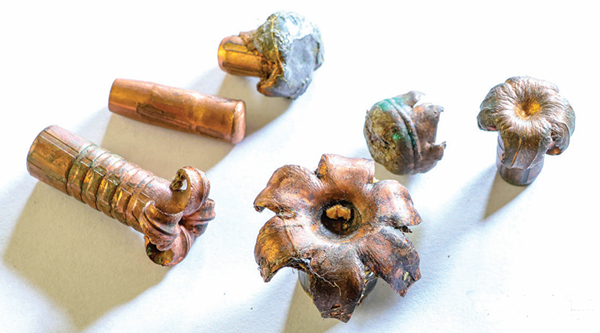
A look at the Last Stop on a Hunting Bullet’s Journey
Story by Phil MassaroPhotos by Massaro Media Group
We ask an awful lot of our bullets, especially those of us who rely on them for self defense or for hunting. We need the bullet to be accurate, we ask it to feed properly from a variety of magazine types, and finally, we want our bullet to perform perfectly once it makes contact with our intended target. The terminal phase of the bullet – that which begins upon impact with the target and ends upon cessation of forward movement or once it exits the target – is what we’re interested in here. It doesn’t matter what the intended target might be – an African Cape buffalo; that fat, gluttonous woodchuck raiding the vegetable garden; or the 10-point buck of a lifetime – that bullet must do exactly what we need it to do. However, bullets cannot read minds, so we shooters need to help our own cause by choosing the best product for the scenario at hand. I’ll warn you, there are many choices, as well as many correct answers for the same question. However, if we put things into a proper perspective, you’ll be able to make a more informed decision and achieve the desired results.

prevent premature bullet breakup; his Partition is a great big game choice to this day.

FIRSTLY, LET’S AGREE on a point: Killing an animal quickly depends on massive destruction of vital organs and tissue. I’ve made an errant shot on an African antelope not much bigger than our deer while using a .416 Remington Magnum, and it ran over 400 yards before we caught up to it to dispatch it. So a big, heavy bullet in the wrong place doesn’t do a hunter much good, while a smaller bullet in the heart/lungs/brain or other blood-rich vital organ will kill quickly. Some animals seem to be more susceptible to “shock,” while others have a much more subdued reaction to the shot, so there may not be a single bullet that will cover every situation. But we can do our best to choose the best tool for the job at hand.
Generally speaking, match bullets are designed for target work only, as they are constructed with no consideration for the terminal phase. I know hunters who use them for big game hunting with mixed results, so I do not recommend them, no matter the accuracy. I do, for example, frequently employ the Sierra Match King bullets for varmints and smaller furbearers, as they are no more frangible than most varmint bullets and their pinpoint accuracy is welcomed in that realm. But I’m shooting a .223 Remington or .22-250 Remington, and at game the size of a coyote or smaller. They’re hell on woodchucks, foxes and other small critters of that size, and that’s where the use of match bullets in the field ends for me.

For varmints like woodchucks, prairie dogs and the like, there are highly frangible bullets designed for these species. Hornady’s V-Max, Barnes’ Varmint Grenade, Sierra’s Varminter – all of these have very thin copper jackets and are designed to be nearly explosive, giving a very rapid energy transfer. These animals don’t require a ton of penetration due to their size, and that fast expansion upon impact does all sorts of damage. These bullets are also frangible enough to give proper expansion, even at long ranges when the impact velocities are lower. Want to create the famous “red mist”? Serve a frangible varmint bullet squarely on target at a high velocity and it’ll all be over quickly.
Furbearers are a different story, as many hunters are interested in best preserving the pelt, and two schools of thought are generally followed. First is to use a full metal jacket bullet, as they do not expand and generally leave small entrance and exit wounds. Second is to use a light, highly frangible bullet, which tend not to exit. I’ve used both and tend to lean on the FMJs, as the number of coyotes in our hunting area far exceeds the number of foxes. Your mileage may vary, but I’ll say that the FMJs do less damage to fur, but the varmint bullets kill faster, especially on larger Eastern coyotes, unless we’re discussing headshots.
THE WHITETAIL DEER is America’s favorite game animal, and with good reason: They are widespread, they offer fantastic table fare and the hunting experience is something quite obviously unparalleled. Each year, deer are killed with any number of centerfire rifles, muzzleloaders, shotguns and handguns, not to mention all the archery gear. All sorts of projectiles are used, from the patched lead balls of the front loaders, to the traditional cup-and-core jacketed bullets that our grandfathers relied on, to the polymer-tipped spitzer boattail designs featuring a bonded core or mono metal construction. Deer aren’t especially hard to kill, unless you hit them wrong, and then you’ve got a problem on your hands. In the centerfire cartridge realm, many hunters are happy to use the .22 and 6mm calibers, and with our modern bullets they can be wonderful.
I tend to hedge my bets, as a crack at a black bear is a definite reality in my neck of the woods, so my deer guns range between 6.5mm and .30 caliber. With deer and similar-sized game, a blend of expansion and proper penetration has always given me the best results. I like bullets in the middle to the heavy side of the weight spectrum to guarantee enough penetration. I do like the Sierra GameKing, the Hornady Interlock and ELD-X, the Federal Power Shok, as well as Nosler’s Ballistic Tip and Solid Base bullets. I’ve used the Winchester Power Point and Remington Core-Lokt with great results, but again, I like to have a bit of bullet weight. I’ve seen a number of light-for-caliber bullets fail to give proper penetration, as they expanded prematurely and left a superficial wound. Those deer were found days later, and quite by accident, and we found that the wound channel was just too shallow for a quick kill. For cup-and-core bullets, stick to the heavier side of things and you’ll be grinning in the trophy photo.

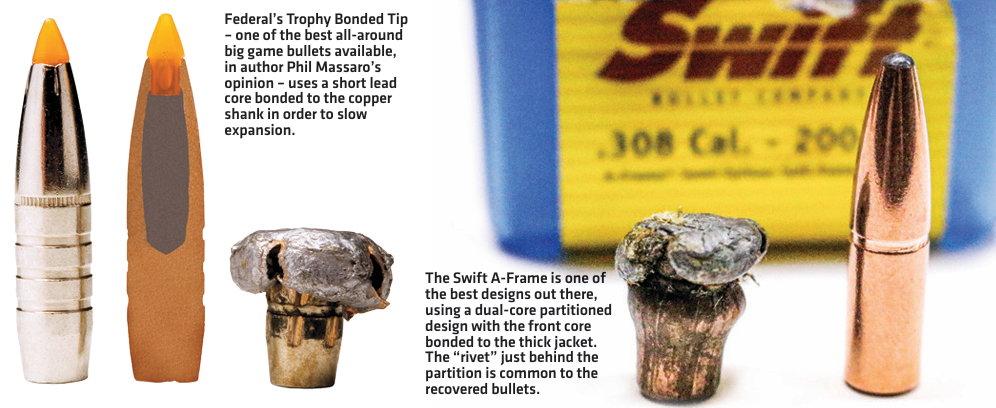
Looking at the premium bullets for deer, I don’t see a real problem, but you might see a more dramatic effect when using softer projectiles. I like those bonded-core designs like the Swift Scirocco II, Federal Trophy Bonded Tip and Nosler AccuBond, as they take full advantage of their polymer tip, which acts like a wedge to initiate – and guarantee – expansion. The chemical bonding of the jacket and lead core holds the bullet together better than any non-bonded design, offering deep penetration. In fact, with a good number of these designs, bullet recovery is often impossible, as they tend to exit deer and other species of the same size. The Nosler Partition, which uses a dual core design separated by a wall of gilding metal, and the Swift A-Frame, which is similar but sees the front core bonded to the jacket, are both famous for their performance on larger game species but will certainly do the job on deer. The Partition is, in my opinion, the better of the two, as it gives a better blend of expansion and penetration due to its softer front core.

LARGER GAME SPECIES like elk, moose and the large bears, as well as many of the African antelopes, can certainly be handled easier by using a premium bullet. Many times these species are the central focus of someone’s “hunt of a lifetime,” and I always like to err on the side of caution. Federal’s Terminal Ascent and Trophy Bonded Tip; Barnes’ TSX, TTSX and LRX; Hornady’s CX; Swift’s A-Frame and Scirocco II; and Nosler’s Partition, AccuBond and AccuBond Long Range are all great do all projectiles for larger game, as they can handle the thicker hides and large bones you’re going to have to deal with. I’ve never once had one of these bullets “fail,” though some of the early versions of the Barnes monometal bullets did fail to open. This has not been the case with anything I’ve used in the last decade or so. If one of these projectiles is properly placed, you’d better grab your camera and plan the pack out.

As a last note on this category of game, many folks ask me about the Berger line of projectiles, and I’ll say this: Berger’s stuff is among the most consistent and accurate on the market. However, I’ve had a number of hunters, professional hunters and outfitters alike who have observed that they are also a highly frangible design, and this is undesirable for tougher game, especially when shots are close and impact velocities are high. Turning to the dangerous game species of Africa and Australia, you’ll find many of the rules and guidelines handed down are over a century old, and perhaps the handbook needs to be revised. Bullets for African game are often referred to as “solids” (non expanding, full metal jacket bullets)
and “softs” (expanding soft point projectiles). The rule of “solids only for elephant” still applies, but I really like some of the modern monometal designs – some of which actually offer the slightest bit of expansion – like the Woodleigh Hydrostatically Stabilized Solid and the North Fork Cup Solid, or the bonded-core Federal Trophy Bonded Sledgehammer. All offer the seriously deep penetration required to quickly and effectively stop and kill an elephant or hippopotamus, which have very thick hides and enormous bones.
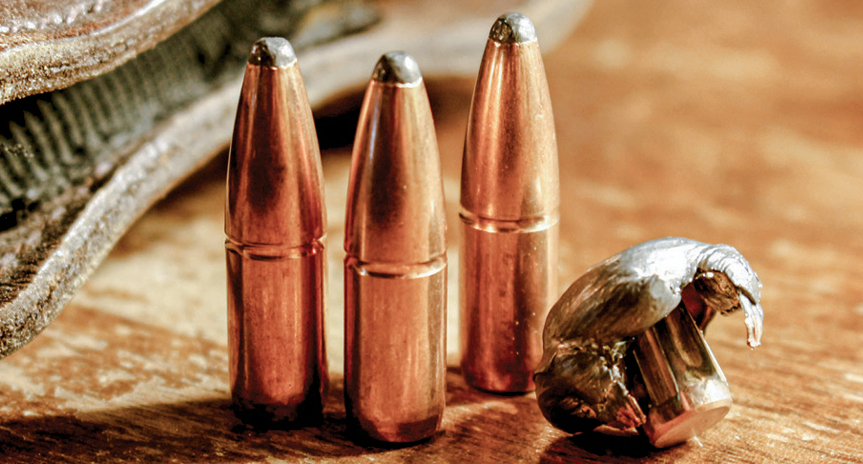

The Cape buffalo is one of the most popular species hunted in the dangerous game category, and the time-honored recommendation was a soft for the first shot, with solids thereafter. I think this needs to be revised, as the modern soft points will deliver the needed penetration from nearly any angle without the risk of overpenetration that solids present; you definitely run the risk of wounding or killing another animal in the herd. For buffalo, I like the Swift A-Frame, Trophy Bonded Bear Claw, Woodleigh Weldcore, Peregrine Bushmaster (an amazing South African bullet) and Barnes TSX; in a proper cartridge they are absolute hell on Cape buffalo.
IN THE END, depending on the game animal at hand, you want a bullet of proper weight for your chosen cartridge, capable of giving the expansion desired for a large wound channel yet tough enough to hold together for deep penetration. The goal is always to destroy as much vital tissue as possible to ensure a quick kill for the game animal. Weight retention – the amount of the bullet’s weight retained after taking an animal – is often discussed as an important part of what makes a good hunting bullet, as a bullet that doesn’t break up prematurely usually gives good terminal performance. Just remember that the expanded diameter of the bullet is also an important factor, as it greatly increases wound channel size. ★