

From his days in Delta Force to recovering from combat injury, acting and podcasting to designing a unique handgun sight, Tyler Grey embodies what’s possible.
STORY BY LINDA AND PAUL PAWELAPHOTOS BY STAFFORD BAIN VISUALS
In an industry where authenticity is often manufactured, Tyler Grey stands apart. Soldier, survivor, actor, technical advisor, podcaster and entrepreneur, Grey has built a career on something Hollywood can’t replicate: lived experience. Before stepping onto a film set, Grey served in the US military’s most elite unit: Delta Force. After a grueling selection and assessment process, he joined the tier one counterterrorism unit tasked with some of the most sensitive missions in modern warfare.
Delta operators are known for discipline, adaptability and obsessive attention to detail, traits that would later shape Grey’s second career. He deployed multiple times to combat zones, operating in environments where preparation and teamwork meant the difference between life and death. Let’s pause for a moment, as this sounds like how someone would define the word “hero,” right? “A person admired for exceptional courage, noble qualities or outstanding achievements, often risking themselves to help
others. Also: selflessness, bravery and resilience. More to the point, a real life rescuer, all the traits that make for mythological figures in books and movies.” The irony is that while Grey is all of that and then some, he is a very humble, salt-of-the-earth kind of man. Strangely, Grey doesn’t think of himself as a hero nor consider himself one. Sir, no disrespect, but here is where the authors will disagree with you: Everyone knows you and your brothers-in-arms are all heroes!
GREY’S MILITARY CAREER was cut short by a devastating combat injury sustained in a suicide bombing. The blast caused severe physical trauma and forced him into a long and difficult recovery. For many, such an injury would mark the end of forward momentum. For Grey, it marked a pivot. Recovery required not only physical rehabilitation, but also mental recalibration. Transitioning from the intensity of special operations into civilian life can be disorienting. Grey approached it the same way he approached mission planning: with structure, discipline and intent. Grey initially entered the film and television world as a technical advisor, ensuring authenticity in military portrayals. He quickly proved invaluable. Directors and producers recognized that he wasn’t simply choreographing movement; he was delivering realism grounded in muscle memory and experience. From how a rifle is mounted to how a team clears a room, Grey brought nuance that audiences may not consciously identify but instinctively recognize.
His behind-the-scenes work eventually evolved into an on-screen role in the hit television series SEAL Team. Unlike many actors who learn to portray special operators, Grey didn’t have to act confident; he embodied it. His presence in Hollywood
coincided with a broader shift in how military stories are told. Today’s audiences are more informed. They can tell when tactics look forced or when dialogue feels artificial. Grey has helped narrow the gap between dramatization and reality. He has spoken openly about the responsibility of portraying service members accurately, not as caricatures, but as professionals shaped by brotherhood, sacrifice and accountability. For him, storytelling isn’t about glorifying war; it’s about honoring those who lived it.
Grey expanded his reach through podcasting as cohost of 2 Fake SEALs alongside fellow SEAL Team actor AJ Buckley. The show blends humor with candid discussion about military culture, Hollywood portrayals, current events and the blurred lines
between fact and fiction in the special operations community. The title is intentionally tongue in cheek, a nod to the phenomenon of “stolen valor” and fabricated service records. Through sharp conversations and interviews, the podcast tackles serious issues
affecting veterans while maintaining an irreverent tone.

Justin Melnick, Grey, David Boreanaz, Beau Knapp and
Judd Lormand. (© 2020 CBS BROADCASTING INC.)
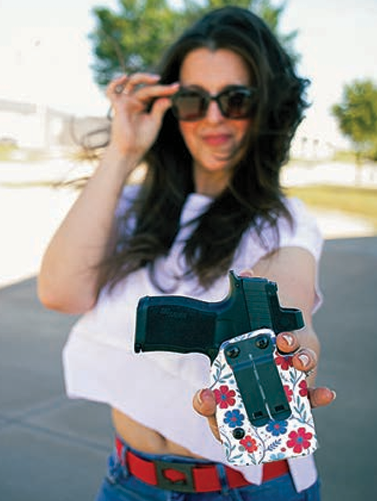
THAT MINDSET EXTENDS directly into Grey’s entrepreneurial ventures. Grey’s former unit was big on handgun proficiency, and he shot thousands and thousands of rounds. Like other units, they were taught “front sight focus,” which was just the way it was done. But it never felt right to Grey to be looking at the sights. So he started asking people why they did it that way, and the answer was always the same: “I don’t know, that’s how it’s always been done.” Then, on one of his combat deployments, something clicked that he couldn’t shake: You have to focus on your target in a gunfight, so why were they teaching something in
training only to do the opposite in reality? He brought it up to others, and everyone agreed it was a problem – but like him, they had no solution. After Grey was injured and medically retired, the thought didn’t go away; in fact, it became stronger. He realized that gunfighting and flat range target shooting have almost nothing to do with each other. The problems became clearer and clearer, but the solution still wasn’t there.
Then one day, while working on a movie set, the director held up his fingers and “framed” a shot showing what he wanted to capture on film. That’s when it hit Grey: When we want to see something clearly, we frame it. But when we shoot, we block half of it with a front sight post. Now there were two problems locked in his mind: First, you must focus on the target in combat; and second, why are we blocking half of what we need to see? Later that day, sitting down to eat, Grey noticed two ketchup bottles, one of which was glass with the opening at the top, the other plastic with the opening at the bottom. For some reason, that was the moment everything came together. The solution was to stop fighting the laws of nature. The brain wants to focus on the target, so make the target the front sight, and get rid of the front sight altogether. It sounded crazy. But how long did people struggle with the Heinz bottle before someone finally said, “What if we stop fighting gravity and put the opening on the bottom?” The idea behind NDEX sights was the same: stop fighting how the brain and body naturally work. Let the shooter focus on the threat. Remove anything that blocks the shooter’s view and allow them to see the entire target to determine whether it’s truly a threat. Grey told around 50 experienced shooters and knowledgeable people. Every single one said the same thing: “It can’t work.” When he asked why, the answer was always identical: “Because if it did, someone would have already done it.” That was the moment he knew he had to pursue it.

IT TOOK SIX years to figure out the measurements because everything had to be created from scratch; nothing from existing sight systems could be used. Grey was also working full time, and he wasn’t a machinist, engineer or product designer; his background was in nylon gear. Once he had a working prototype, he spent three years testing it himself. No one else saw it. Grey pushed the design in every way imaginable and learned it inside and out. He wanted to have an answer for every possible question because he knew there would be a tidal wave of skepticism once it was released.
Then Grey started working on SEAL Team, and for seven years he was too busy to launch anything. So everything – development notes, prototypes and versions – went into a box and was shelved. About a year ago, someone broke into Grey’s storage unit and stole that box. Everything was gone. Twelve years of work gone, because there were a few Glock slides inside and the thief took the whole thing. At first, Grey couldn’t believe it. For days, he thought it had to be somewhere else. But eventually, the reality set in. It was gone. He was devastated for a full week.
Then something shifted. Grey saw it differently: that theft wasn’t the end, it was a message. A push to stop waiting and finally finish what he started. Instead of a devastating loss, it became a call to action. That day, he made a promise to himself and to God that he wouldn’t stop until it was done. Grey went back to the drawings he still had. They weren’t perfect, but most of the measurements were there. It took another six months to rebuild what was lost, and about a year after the theft, he had working models again. Then came the next obstacle: money. Grey didn’t have enough to fund production, and machine shops require minimum orders. The show had ended, Hollywood work had dried up, and resources were limited. Still, he was fully committed. He scraped together what he could and put down 20 percent for production without knowing how he’d cover the
remaining 80 percent.


The order was finished sooner than expected. Grey still didn’t have the money, but someone stepped in, believed in him, and helped him complete it. That was four months ago. Now he’s ready to bring it to the shooting community and see what the market
says. Grey stands behind it completely, believing these sights are better for defensive shooting than traditional front posts, and he’s willing to put his name and reputation on it.

This project represents years of work, sacrifice and persistence. It wasn’t an easy road, but it is finished. Almost everyone said it wouldn’t work, and yet here it is. Every new idea looks crazy at first until people open their minds, try it, and realize it works. Then it becomes the new standard. So the question is simple: Are you going to be one of the people who says, “That’s how it’s always been done” or one of the people willing to ask, “What’s possible?”
GREY’S MOST PERSONAL project to date is his memoir, Forged in Chaos: A Warrior’s Origin Story. The book chronicles his journey from a young man seeking purpose, through the crucible of Delta Force selection and combat deployments, to the life-altering injury that forced him to rebuild his life from the ground up. More than a military memoir, Forged in Chaos explores identity, trauma, anger and reinvention. After his injury, Grey faced not only physical recovery but the emotional fallout of losing the role that had defined him. For a time, he struggled with pent-up anger and the sudden absence of the structure that had shaped his life. He had lived in controlled chaos for years; now he had to reinvent himself without it. The book’s central message mirrors his life: chaos can either consume you or forge you. Strength isn’t simply physical dominance; it’s the ability to endure, adapt and reorient when everything changes.
What makes Grey’s story compelling isn’t just the résumé; it’s the continuity of purpose. The battlefield, the soundstage and the product workshop may seem like separate arenas, but for Grey, they’re connected by one constant: standards. In special operations, standards are unforgiving. In film, authenticity builds credibility. In product design, performance defines reputation. Grey understands that excellence transfers. Grey also represents a broader narrative about veteran reinvention. The transition out of elite military service can be isolating, but his path demonstrates how discipline, attention to detail and leadership can evolve into creative and entrepreneurial success. As Grey continues to act, podcast, write and innovate within the firearms industry, he occupies a rare spot as a public figure rooted in the ethos of special operations. He doesn’t depend on spectacles. Grey relies on experience. For Tyler Grey, authenticity isn’t branding. It’s the forge. ★